
0new
biopsy.
Investigating treatment benefitfrom the H&E slide in ovarian cancer.
Which patients benefit most from maintenance therapy in advanced ovarian cancer.
RESEARCH USE ONLY
Not for diagnostic or treatment-selection use
Help match treatment intensity to each patient’s needs.
Treatment benefit research in advanced high-grade ovarian cancer, read from the pretreatment slide.
0extra
tissue.
0new test
to order.
TWO RESEARCH QUESTIONS
Two studies for ovarian cancer
treatment response prediction.
One study evaluates heterogeneity of benefit from a specific maintenance regimen. A separate study evaluates whether HRD status can be predicted from routine H&E slides.
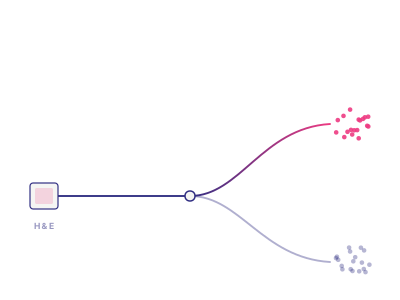
In PAOLA‑1, a treatment-aware model compared predicted progression risk under olaparib plus bevacizumab and bevacizumab alone to derive a continuous ETI score.
A separate model evaluated whether HRD status could be predicted from routine H&E slides. This work investigates support or triage for molecular testing, not its replacement.
PAOLA‑1 · TREATMENT-EFFECT CONTRAST
DiaThera separated patients by estimated benefit from adding olaparib.
At
DiaThera
HRD
For each method, the chart compares estimated treatment benefit in the positive or responder group with the negative or non-responder group. The point marks the estimate, the bar its 95% confidence interval, and each dot one percentage point. Source: Frenel J-S, et al. npj Digit Med. 2026.
HRD STATUS · ETI STRATIFICATION
Related signals.
Not the same classification.

ETI stratified predicted treatment benefit within both HRD-positive and HRD-negative groups in the 421-patient PAOLA‑1 analysis.
HRD-positive
243
195ETI responder
80.3%
48ETI non-responder
19.7%
HRD-negative
178
6ETI responder
3.4%
172ETI non-responder
96.6%
ETI responder status was defined in the published analysis from the model-derived treatment-effect score. Source: Frenel J-S, et al. npj Digit Med. 2026.
H&E-BASED HRD PREDICTION
Developed once.
Evaluated across cohorts.
A separate deep-learning study evaluated HRD prediction from routine whole-slide images in one development cohort and two external cohorts.
IHP-OV
PAOLA‑1
TCGA
NEGATIVE PREDICTIVE VALUE
Up to 0.98 for identifying HRD-negative cases in the reported analyses.
PROGRESSION-FREE SURVIVAL
In olaparib-treated BRCA-wildtype patients, AI-predicted negative groups showed progression-free survival curves nearly identical to Myriad-defined negative groups.
Source: Frenel J-S, et al. Int J Gynecol Cancer. 2026;36:104717. HRD prediction and treatment-benefit estimation are separate research models and analyses.
RESEARCH COLLABORATION
Turn treatment outcomes into a research program.
Bring together whole-slide images, treatment assignments and longitudinal outcomes with the DiaDeep team.
Discuss a research projectPEER-REVIEWED EVIDENCE
Read the
source studies.
Review the populations, endpoints, methods and limitations reported in the original ovarian cancer publications.
Treatment-aware deep learning enables counterfactual prediction of individual benefit from PARP inhibitors in ovarian cancer
Homologous recombination deficiency (HRD) assays are used to select patients with ovarian cancer for PARP inhibitors, but they do not fully capture the…
Read more ↗︎Deep learning-based prediction of homologous recombination deficiency from histopathological whole-slide images in ovarian cancer
Homologous recombination deficiency is a critical biomarker for guiding first-line treatment with poly(adenosine diphosphate-ribose) polymerase inhibitors in…
Read more ↗︎Artificial intelligence to predict homologous recombination deficiency in ovarian cancer from whole-slide histopathological images.
In the field of ovarian cancer diagnosis, predicting Homologous Recombination Deficiency (HRD) holds paramount importance for personalized treatment…
Read more ↗︎